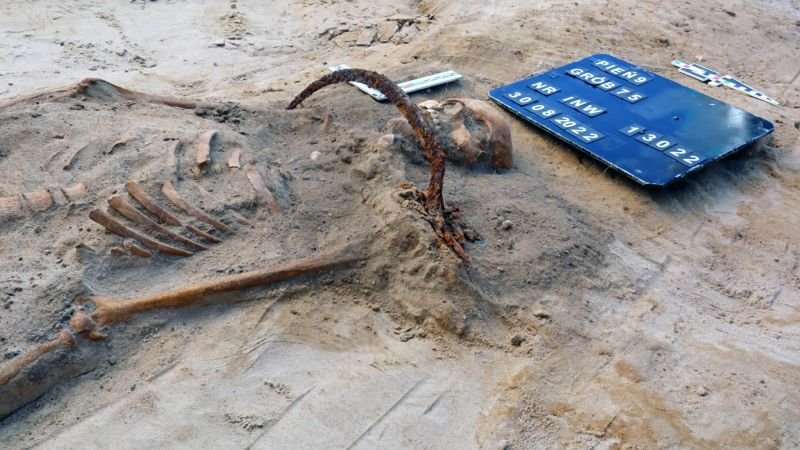
A 400-year-old grave unearthed in northern Poland has drawn attention for its peculiar contents, including the remains of a young woman, now referred to as Zosia, with a sickle placed over her throat and a padlock fastened to her foot — indications of a community’s fear that she might return from the dead, reports BritPanorama.
The grave was discovered in 2022 near the village of Pień, and the subsequent examination revealed a skeleton that has sparked significant media interest. The 2024 documentary “Field of Vampires” features the research team as they reconstruct what Zosia may have looked like.
Recent research, involving ancient DNA analyses, has attempted to uncover details about Zosia’s identity and the circumstances of her death, exploring why she was seemingly feared as a vampire. Dariusz Poliński, lead author of a study published on July 30 in the Journal of Archaeological Science: Reports, noted the unusual precautions taken at her burial — two methods of restraint — suggest a significant anxiety about her possible return to life.
Poliński, a professor at the Institute of Archaeology at Nicolaus Copernicus University in Toruń, has been excavating the Pień site since 2005, uncovering a cemetery that spans roughly four generations from the 17th century, with at least 101 graves documented. The burial site is considered likely to be of Protestant origin, with the absence of traditional Catholic burial items such as crosses. Although padlocks have been found at Jewish cemeteries within Poland, this site lacks the features typically associated with Jewish burials.
The found padlock was discovered to be unlocked when retrieved, and the sickle, made from wood, was positioned over her neck later in the burial process. This positioning implies that the grave had not been disturbed after Zosia had fully decomposed, pointing to the sickle being added while soft tissues still held her skeleton together. An object with properties of copper and gold was also identified in Zosia’s mouth or nasal cavity, possibly intended for anti-demonic protection as it left a greenish stain on her palate.
Ancient burial practices varied widely, and according to John Blair, a professor emeritus from the University of Oxford who commented on the study, such treatments suggest that these individuals were believed to pose a danger to the living. The study noted that these distinctive burials may signify societal rejection, and the analysis highlighted the practice as particularly pronounced in 17th-century Poland.
Unusual burials
In the Pień cemetery, some burials displayed what the researchers termed “deviant” or “atypical” behaviors. Examples include a child buried face down, some skeletons posed dramatically, and others with stones encircling skulls. These findings suggest that the cemetery served as a last resting place for those that society may have marginalized, without regard to their social status.
The context of these burials indicates a possible ritual to dissuade the deceased from returning as threatening entities. Such practices were often undocumented, explaining the scarcity of sources discussing these burial rituals. Societies in that era frequently performed unconventional burials for suicides, heretics, and those considered outsiders or ill-fated.
Was Zosia an outsider?
The research team also aimed to ascertain Zosia’s background through isotopic analysis of her remains, although results regarding her potential outsider status remain inconclusive. The isotopes reflected local consumption patterns, leading the researchers to suggest she likely grew up in the area. However, her mitochondrial DNA indicated a possible link to more distant Scandinavian ancestry, albeit without definitive conclusions.
According to Shai Carmi, an expert who has examined similar graves, the study’s reliance on mitochondrial DNA limits the insights available on her lineage. His points cast uncertainty on the ability to draw significant ancestry conclusions due to the non-unique nature of mitochondrial lineages in European populations.
Recent examinations indicated that Zosia was likely from a higher social status family. Traces of luxurious silk found near her remains contained threads of pure gold and silver. In fact, the burial robes of notable figures from the same period lack these threads, suggesting Zosia’s family might have been considerably affluent.
After identifying possible health conditions such as a haemangioma in her sternum in earlier studies, further analyses found no substantial evidence to indicate trauma or other diseases led to her death. Investigations are ongoing, aiming to determine the cause of her death and the societal fears surrounding her burial practices.
Ultimately, the obsessive care taken in Zosia’s burial points to a deeper cultural anxiety regarding death and the undercurrents of supernatural beliefs surrounding those regarded as deviant in life. As the research progresses, further insights from this significant archaeological find are expected to unfold.